Floor clip · 0:30 · Dongguan
Flatlock sewing,
filmed on our floor.
Thirty seconds at a flatlock station on our Dongguan floor. The seam lies flat on both faces, so nothing rubs against the skin — the join we use on leggings, sports bras and training sets.
What to look for
- Four-needle, six-thread flatlock — the seam sits level instead of forming a ridge.
- Panels butted edge to edge, then stitched across, for a chafe-free join.
- The same construction that runs on our Yamato / HIKARI equipment in bulk.
- Length
- 0:30
- Format
- Vertical 9:16 · no sound
- Filmed
- Our sewing floor, Dongguan — not stock footage
Construction notes
Where flatlock earns its place — and how to spec it.
Flatlock is the seam buyers notice by touch first. It joins two panels with no seam allowance folded inside, so the inside of a legging feels as smooth as the outside. This is how we read it when a tech pack lands on the desk.
Where it goes
- Leggings — inseams, side seams and gusset joins that sit against the skin.
- Sports bras — side and underband seams that move with every rep.
- Training tops and sets — raglan and panel seams where a ridge would rub under a strap.
- Design lines — in a contrast thread, the stitch itself becomes a styling detail.
Spec it like this
- Stitch type: ISO 4915 class 607 — four-needle, six-thread flatseam. Write “FS 607” or “flatlock 4N6T” on the construction page.
- Stitch density: state SPI (stitches per inch) on the tech pack; we match it on the first sample.
- Thread: textured (bulked) polyester or nylon in the loopers keeps the hand soft against the skin.
- Placement: mark which seams are flatlock and which are overlock — mixing the two is normal and keeps cost in check.
Check it on your sample
- Stretch the seam to the fabric’s working stretch: stitches recover, no popped threads.
- Run a finger along the inside: no raised ridge, no exposed raw edge.
- Look at the intersections — crotch and underarm — where bulk shows up first.
- Wash once and look again: puckering after washing points to tension or thread choice.
Three stitches, three jobs
| Stitch | What it does | Typical use on activewear |
|---|---|---|
| Flatlock This clipISO 607 | Joins two panels butted edge to edge; smooth on both faces. | Leggings inseams, sports-bra side seams, panel seams against the skin. |
| CoverstitchISO 406 / 407 | Hems and binds; parallel needle lines on the face, looper covering the raw edge inside. | Hems, cuffs, waistband and neckline finishing. |
| OverlockISO 504 / 514 | Joins and neatens the edge in one pass; leaves a small ridge inside. | Internal seams where touch matters less; efficient in bulk. |
Questions buyers ask
Is this footage of your own factory?
Yes. It was filmed on our sewing floor in Dongguan, not stock footage. You are welcome to book a visit and see the same stations in person.
Does flatlock add cost?
It runs slower than overlock and uses more thread, so we put it where comfort matters and overlock where it does not. We tell you at quotation which seams we propose in flatlock.
What does it take to see this on my own design?
Send a Development Brief with sketches or a tech pack. Samples are US$50–100 per garment piece; bulk starts at 150 pcs per style per colour.
More from the floor
Capabilities →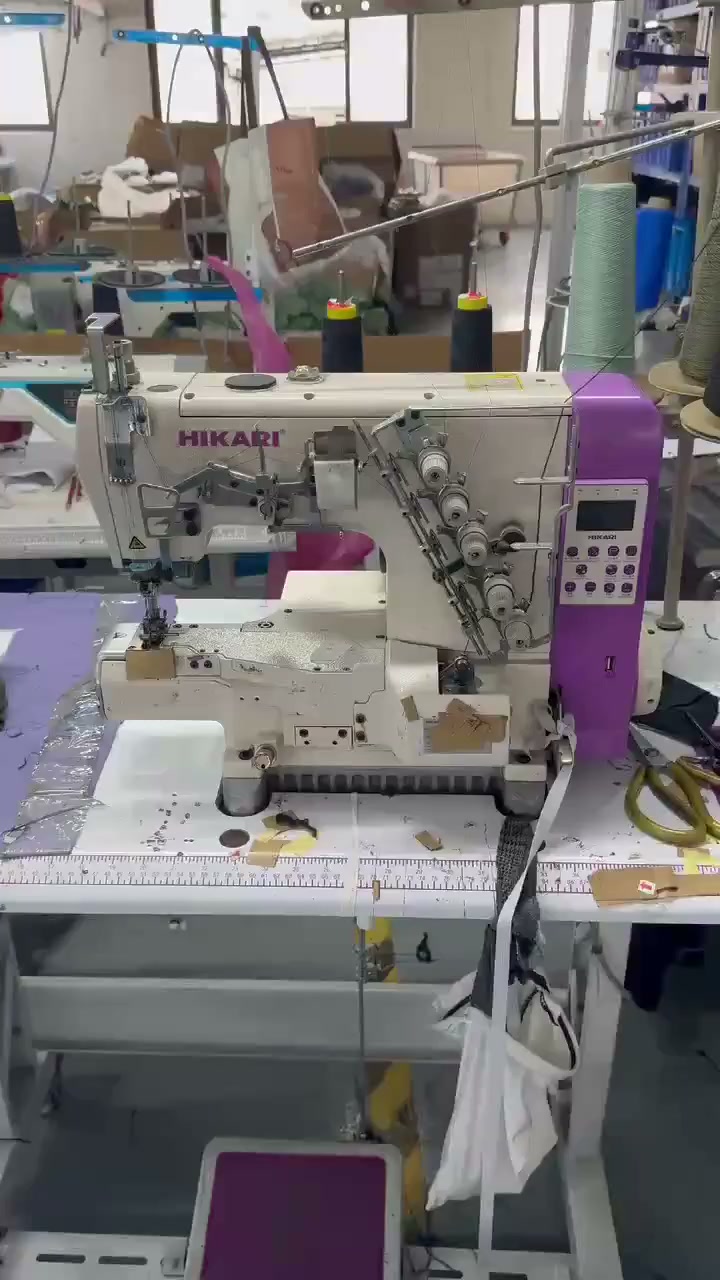 0:02